
Can Machine Learning Predict Star Trek's Most Popular Commander Cards?
I’m building Manayard, a tool for finding Magic: The Gathering cards that work together in Commander. On the side, I wanted to know whether a computer could learn from older cards to guess which new cards people will put in their decks. I’m a beginner at machine learning, so treat this as an experiment, not expert advice.
The test case is Magic’s Star Trek release: the main set, TRK, and its Commander decks, TRC, both out on November 13. I forecast all 191 new cards revealed by October 20: 70 commander candidates, 107 other spells and 14 lands. Reprints and basic lands are left out.
“Popular” here means how many Commander decks include a card, measured by the popularity rank in Scryfall’s public card data. It is not win rate or power level.
The questions
- Can a model trained on older cards predict which new cards Commander players will use most? Roughly. Its order is far better than random, but it rarely spots the breakout card of a release.
- Does anything beat a simple model that only reads card text? Not reliably. A blend of two models won my first test, but its lead disappeared in two later tests.
- What does it forecast for Star Trek? The Borg Queen and Captain Jean-Luc Picard lead the commanders, and Starship Enterprise leads the other spells. The Sets page ranks every card and shows what raised or lowered its score.
How a forecast is made

Hiding the name means a model can’t simply remember that a famous card is popular. A new card is read the same way and gets a score; a higher score means the model expects it in more decks.
The text model is the baseline every other method has to beat. A card’s score is the sum of its phrases’ weights. The technique is called ridge regression; “ridge” stops any single phrase from getting an extreme weight.
The pairwise model works like a taste test that asks “which of these two?” instead of “rate this out of 10.” It compares commanders only with commanders, and it reads facts from Manayard’s parser, which turns rules text into structured effects, costs and conditions.
The blend turns each model’s score into a percentile: the share of older cards that scored lower. A card above 90% of older cards in one model and 96% in the other gets a blend score of 0.93.
How I tested the methods
To test a forecaster fairly, you hide the answers. I trained each method on older cards, asked it to rank later cards whose popularity I already knew, then compared.

I chose the blend after test 1 and froze it before running tests 2 and 3. Test 1 is a practice exam: because I picked a winner there, it flatters the winner. Test 2 is a repeated exam, because I had looked at those six releases in earlier experiments. Test 3 is fresh but early: one release family whose popularity ranks were only 18 days old.
The score is the Spearman correlation, which compares two orderings. Think of predicting the finishing order of a race: an exactly right order scores 1, a guess with no relation to the result scores about 0, and an exactly backwards order scores −1. I compute it within each release, so a card is only compared with cards that came out alongside it. Commanders are harder to predict than other cards, so each score is the average of two correlations: one for all cards and one for commander candidates only.
The best method: a text-and-pairwise blend
| Method | Test 1 | Test 2 | Test 3 |
|---|---|---|---|
| Text model (baseline) | 0.469 | 0.580 | 0.669 |
| Text plus updated parser facts | 0.465 | 0.568 | 0.687 |
| Five nearest older cards | 0.253 | 0.273 | 0.380 |
| Pairwise model | 0.471 | 0.555 | 0.656 |
| Boosted trees | 0.445 | 0.497 | 0.630 |
| Learning-to-rank trees | 0.389 | 0.460 | 0.554 |
| Text + pairwise blend (selected) | 0.489 | 0.572 | 0.679 |
| Text + parser-fact correction | 0.483 | 0.559 | 0.714 |
The blend won test 1, 0.489 against 0.469 for the text model, so I picked it. In tests 2 and 3 it landed close to the text model: a little behind in one, a little ahead in the other.

To check whether a gap like that is real, I redrew the releases at random many times and recomputed it. Every range crosses zero, so I can’t tell the blend’s lead from luck.
The Star Trek forecast
For the forecast I retrained the blend on all 32,048 older cards and ranked the 191 Star Trek cards within their categories. “Text-only” is the same card’s place in the baseline text model.
| Commander candidate | Set | Blend | Text-only |
|---|---|---|---|
| The Borg Queen | TRC | 1 | 1 |
| Captain Jean-Luc Picard | TRK | 2 | 2 |
| Dr. Joseph M’Benga | TRK | 3 | 5 |
| Dr. Beverly Crusher | TRK | 4 | 3 |
| Quark, Humble Proprietor | TRK | 5 | 6 |
| Worf, Honor-Bound Warrior | TRK | 6 | 7 |
| Captain Kathryn Janeway | TRK | 7 | 8 |
| Dal R’El, Augment Orphan | TRK | 8 | 10 |
| Locutus of Borg | TRC | 9 | 9 |
| Captain Michael Burnham | TRK | 10 | 11 |
| Other spell | Set | Blend | Text-only |
|---|---|---|---|
| Starship Enterprise | TRC | 1 | 2 |
| Starfleet Communicator | TRC | 2 | 3 |
| Live Long and Prosper | TRK | 3 | 1 |
| Deep Space 9 | TRK | 4 | 5 |
| U.S.S. Reliant, From Hell’s Heart | TRK | 5 | 12 |
| Command Chair | TRC | 6 | 6 |
| U.S.S. Enterprise-D, Galaxy-Class | TRK | 7 | 4 |
| Borg Cube | TRK | 8 | 9 |
| U.S.S. Discovery, at Black Alert | TRK | 9 | 10 |
| Shields Up! | TRK | 10 | 8 |
All 14 new lands are in TRK. Both models put the same three on top, in a different order: Starfleet Academy, Quark’s Bar and The Unicomplex.
The models agree on the top two commanders and disagree more further down: U.S.S. Reliant is 5th in the blend and 12th in the text model. These tables are the October 20 snapshot. The Sets page is rerun as more cards are revealed, so its order now differs slightly. The 191-card CSV keeps this snapshot.
What failed
These eight methods are a small set I chose to compare, not a survey of machine learning. Within that set:
- Five nearest older cards averages the popularity of the five most similar older cards, measured on the same card features the other models read. Shared type, colors and cost can dominate that similarity. It scored lowest in every test: cards that read alike are not necessarily played alike.
- Boosted trees and learning-to-rank trees build many small chains of yes-or-no questions about a card. Both trailed the text model in every test.
- Text plus updated parser facts stayed within 0.02 of the text model in every test, sometimes above and sometimes below.
- The pairwise model on its own tied the text model in test 1 and trailed it in tests 2 and 3.
- Text plus a parser-fact correction adds a second model that learns where the text model tends to go wrong. It had the best test 3 score, but came fourth in test 2. I had committed to the test 1 winner, so I didn’t switch. Switching after seeing test 3 would be like picking an answer after reading the answer key.
A decent correlation can still miss the cards people care about most. I checked whether each release’s single most-played card landed in a model’s top three. Across tests 2 and 3, the blend and the text model each caught 2 of 9 overall winners and 4 of 8 commander winners. Neither reliably spots a breakout card.
Limitations
- Scores are not probabilities. A blend score of 0.93 does not mean a 93% chance of being popular.
- The labels are young. Test 3’s ranks were 18 days old, and every test uses one snapshot of popularity rather than ranks taken at the same card age.
- Parsing is incomplete. 58 of the 191 cards still have rules text the parser can’t describe, and a clean parse can still be wrong.
- Rules text isn’t gameplay. The model doesn’t play games. It can’t tell how much mana Command Chair makes with your commander, or what Live Long and Prosper is worth after you cast a seven-mana spell.
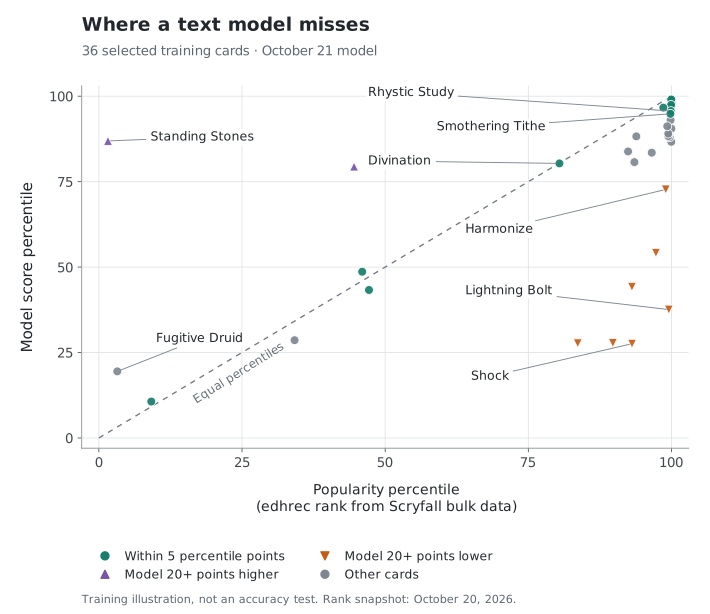
This plot shows the kind of mistake a text model makes, using 36 older cards I picked as examples. A dot on the dashed line means the model got that card right. It underrates Harmonize, Lightning Bolt and Shock, and overrates Standing Stones. These were training cards, so they show the type of error, not accuracy on new cards.
Next steps
After the November 13 release, I’ll grade these forecasts against December popularity, misses included. It will be the first check where no model and no choice of mine saw the answer in advance. Until then the text model stays the baseline and the blend stays an experiment.
After that, I want to test one kind of effect in small, controlled game situations and see whether those results improve a future forecast.
The experiment used no paid services. The code and full method comparison, including separate all-card and commander scores, are in the repository report.
Card and spoiler data: Scryfall’s TRK and TRC listings, as saved on October 20.